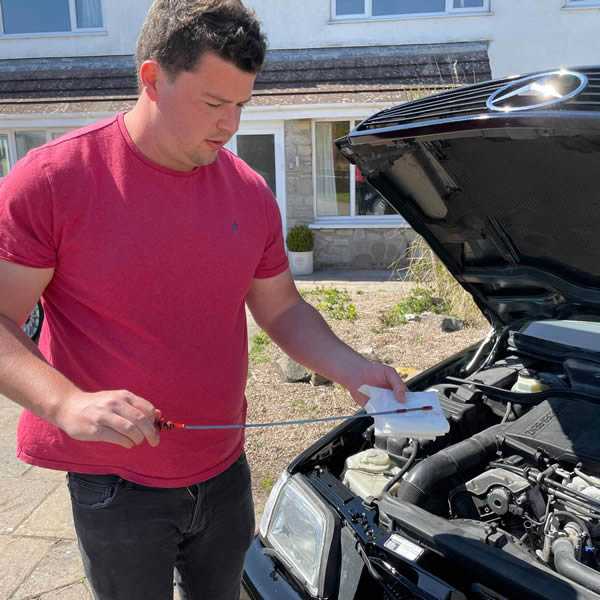
Although keeping your car serviced and avoiding frequent short journeys is key to keeping it running efficiently, it may need a helping hand to lower the emissions prior to an MOT. Whether you drive a petrol or diesel car, both have strict emission tests that they must pass and if the emissions output is too high, it’ll fail the MOT.
Why Do MOT Tests Include An Exhaust Emission Test?
Testing your car’s emissions is a big part of an MOT and it’s required to ensure your engine is operating efficiently. If it isn’t running efficiently, it’ll not only output harmful gases into the environment but it’ll also affect the car’s performance. If your car doesn’t pass the emissions test, it won’t pass an MOT and it’ll require fixing to lower the emissions.
What Car Emissions Are Tested?
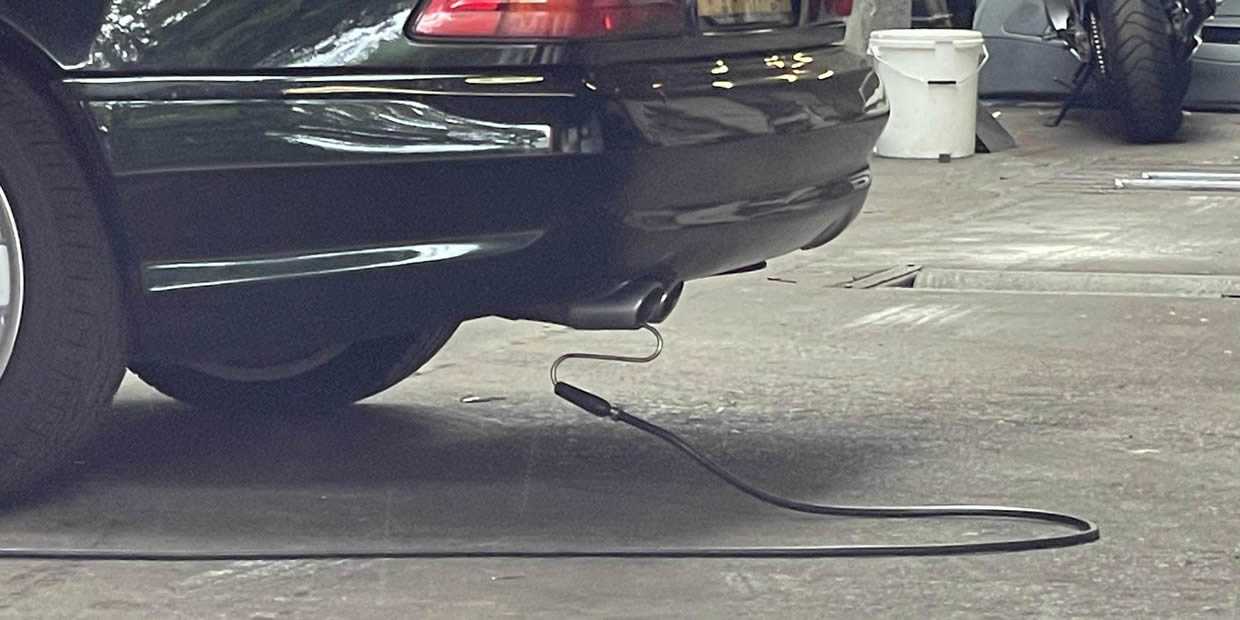
As you can see in the photo above, the emissions test involves placing a probe into the exhaust pipes to take the readings. In terms of the gases that are measured, they are CO (carbon monoxide) and HC (hydrocarbon). Depending upon the year and type of your vehicle will determine the emissions limit that it must reach in order to pass an MOT.
Also tested during an emissions test is the car’s lambda, which also has limits that your car much meet in order to pass an MOT. From the test sheet below, you can see that a car that we took for an MOT failed during both the fast idle test and the second fast idle test. However, during the natural idle test, the CO output was below the limit, which meant that it passed. Unfortunately, due to the fact that it failed the other tests, it didn’t pass the emissions test and MOT.

How To Reduce Car Emissions For An MOT
If your car failed its MOT due to high emissions, below are our recommendations to reduce car emissions in the order of ease and affordability.
1. Take It For A Spirited Drive
One of the easiest methods to reduce car emissions is to take it for a long, spirited drive that involves plenty of fast roads. Also referred to as an “Italian Tune Up“, the end goal is to clear the exhaust system of unburnt fuel and to also get it up to optimum temperature because this is when the catalytic converters work best at reducing emissions. If the car in question has rarely been used or you simply drive it to the shops and back, a spirited drive can be the answer.
Another bit of advice is to ensure that the car isn’t sitting at the MOT station for a long period before the test. This is because catalytic converters work best once they are hot and if it’s had time to cool down, they won’t be as effective. Therefore, it’s advised that you take it for a drive before the MOT test and arrive at a pre-booked time. You could even ask the MOT tester whether it’s possible to test the emissions first whilst the car is at its optimum temperature.
2. Use An Injector or Catalytic Converter Cleaner
The use of catalytic converter and fuel injector cleaners before an MOT is another effective method of reducing car emissions. They work by being poured straight into your fuel tank and mixing with the fuel. This mixture then goes through the combustion cycle to clean out the fuel injectors, engine and exhaust system.
Considering that high-quality cleaning additives cost less than £20 and take just a couple of seconds to pour into your fuel tank, they are highly recommended as a method of reducing your car’s emissions prior to an MOT.
3. Replace The Air Filters
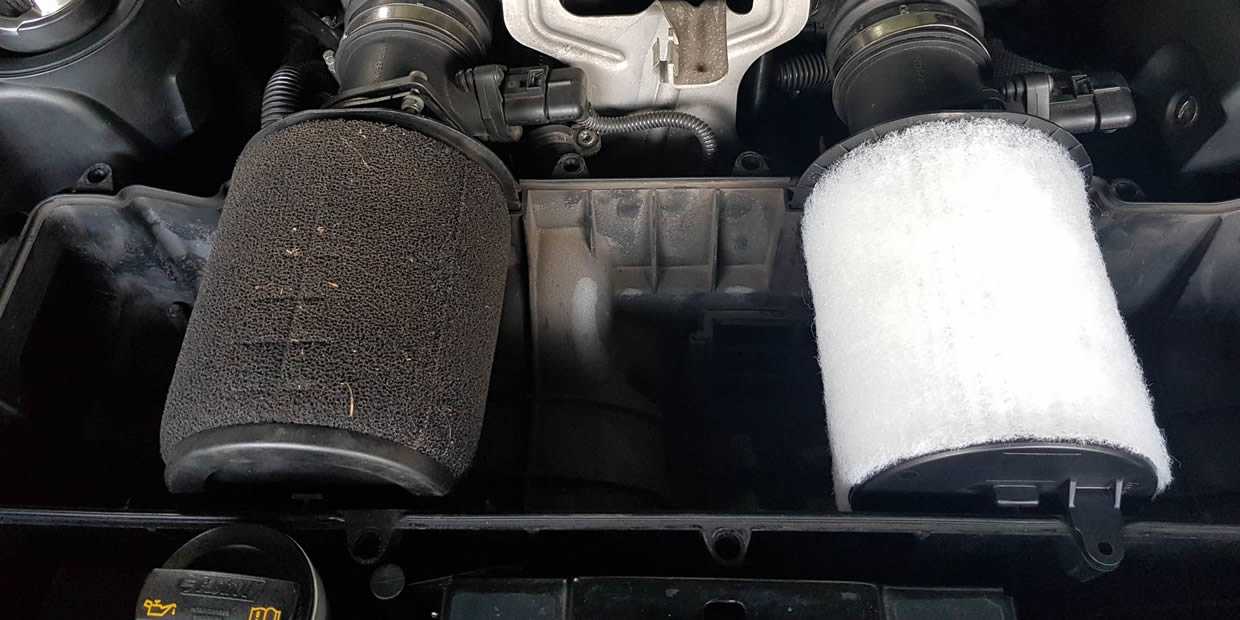
Airflow to the engine is a crucial part of keeping your car’s emissions low and if your car’s air filters aren’t in a good condition, it can alter the air and fuel mixture. If this is the case, the dirty or damaged air filters can then have a knock-on effect because it causes your car to run rich, which has a direct impact on your car’s emissions. Therefore, we would highly recommend that you check that the filters are clean and in good working order.
As you can see in the photo below, we recently changed the air filters of a car that failed its MOT due to emissions. The air filters were the main culprit and after the replacement, the emissions were reduced significantly.
4. Replace The Spark Plugs
Spark plugs that are worn or heavily polluted can throw off the combustion process and result in high emissions. Therefore, ensuring your spark plugs have been changed in accordance with their service schedule is crucial.
Alternatively, you may want to clean the spark plugs and ensure they are all in the same condition (i.e. there isn’t one or two that are more polluted than the others).
It’s also worth pointing out that if you are going to the effort of changing the spark plugs, we would also recommend that you change the engine oil too. Whilst browsing the various oils that are suitable for your car, we would recommend researching the best engine oil for your car. For example, there are many that offer cleaning capabilities that may help towards lowering emissions and improving the efficiency of the engine.
5. Check For Error Codes
If you have access to a car diagnostic tool, plugging it in (or getting a garage to do it for you) may reveal error codes that relate to your car’s emissions being too high. Common faults that coincide with high emissions include a malfunctioning lambda sensor, MAF sensor, coolant temperature sensor and many other components. If a fault is found with a component that plays a role in the car’s emissions, replacing it should solve it.
6. Replace The Lambda/O2 Sensor
Lambda sensors are another crucial component to your car’s emissions and they are a service item that’ll eventually need replacing. Most cars feature multiple and they come in the form of upstream (pre-cat) and downstream (post-cat) sensors. In terms of what they do, they simply make adjustments to the fuel quantity sent to the engine’s cylinders based on the air and fuel mixture. Therefore, it’s crucial that they are working correctly otherwise it’ll output excess emissions.
As you can see in the photo, we recently diagnosed a faulty lambda sensor that was causing high emissions to be outputted when tested at the MOT.
Luckily, the scan tool pinpointed the exact sensor that was problematic and it only cost £100 for the part and £50 for the labour to replace the sensor. However, if you have the budget to do so, we would recommend replacing all the lambda sensors in your exhaust system for complete peace of mind. This is because if one sensor has gone, the other(s) are probably not that far behind.

7. Replace The Catalytic Converter(s)
The most costly method to reduce your car’s emissions is to replace the catalytic converter. Depending upon the age and mileage of your car, it may be due for a replacement and unfortunately, they aren’t cheap to replace.
Due to the fact that replacing your catalytic converter is the most expensive fix, it should be your last resort to lowering your car’s high emissions.
Conclusion
Although you may be looking for ways to cheat the emissions test during an MOT, it’s always worth actually fixing the issue. Not only is it better for the environment and your car’s performance but it’ll also save you time next year when the MOT is due again. All of our suggestions above have been very successful during our years of tackling high emissions but if you require further information, feel free to get in touch and we will try to provide our assistance where possible.